
 Share
ShareBalance Exercises
INTRODUCTION
Balance exercises aimed at improving balance come in two main forms:
- Those aimed at improving imbalance from labyrinthine decompensation. These are called Cawthorne-Cooksey exercises, and are detailed below
- Those for benign paroxysmal positional vertigo. These are called Brandt-Daroff exercises
HOW DOES THE BALANCE SYSTEM WORK?
We achieve the remarkable feat of remaining balanced on two legs by putting together lots of information from sensation in different parts of the body. The brain receives pictures from our eyes, sensation of touch and stretch from the skin and muscles, and of tilt from the balance organs in the ears. It usually manages to work out what is going on in time for us to stop ourselves falling over.
The different types of sensation used in balancing are shown below:
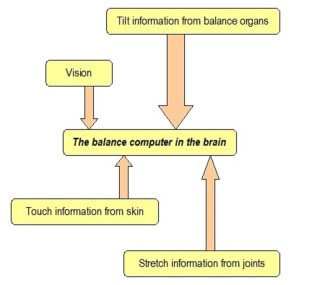
Not only does the balance system help us to stay on our feet, but it also helps us to sense when we are moving and how fast we are going. The balance organs in the inner ear also take note of our head movements, and help us to keep our eyes fixed on one spot when we turn our heads.
A person’s sense of being ‘balanced’ can be disrupted if there are problems with any of the sensory systems shown above. By the time you read this, the diagnostic process has been completed, and the problem has been located in the balance organ of the inner ear, rather than with any of the other sensory systems.
ABOUT THE BLANACE EXERCISES
The function of the balance organ in the inner ear is to monitor your head position and movements, and so dizziness is often caused by movements of the head and body. Once the brain has got used to the signals caused by these movements they will no longer cause dizziness.
An example is the movements of ballet dancers or ice skaters – you may have seen ballet dancers do several rapid turns, one after the other, and then continue to dance without stumbling at all. The reason they can do this is because they have, over the years, trained their brain to ‘tune out’ the dizzy sensations caused by their own movements.
This is how the exercises described in the next section can help people to overcome dizziness.
HOW TO DO THE EXERCISES
1. First, think of any movements that are likely to make you dizzy. For example:
1. Turning your head
2. Getting up from sitting/lying down
3. Lying down
4. Walking or running
5. Rolling over in bed
6. Bending down
2. Then read the exercise list and decide which of the exercises will make you feel dizzy or unsteady. Although they are set out in order of how complex the movement is, how difficult they are for you will depend on which movements make you feel dizzy.
3. Plan how you are going to tackle the exercises. Start with Level One and then move on through all the levels as best you can, only doing one or two of the exercises if that is all you can comfortably cope with. But try and get them done once at least for the initial assessment. After that you should do as many as you can for each level at each session, unless otherwise instructed by your doctor (e.g. if you have arthritis in your neck or spine).
4. When you start with Level One, you may only need to spend 10-15 minutes exercising a day. As you progress through the levels you will need to spend up to 30 minutes per day. You can do levels One and Three together if head movements are a particular problem for you.
THE EXERCISES
Remember, you can do these as slowly as you like. Start slowly, and as you build up confidence, and the sensations subside, speed up. Do not go too far too fast, or continue if an exercise makes you dizzy for more than 15 minutes. It’s best to persevere and expect gradual improvement over a period of time rather than make yourself over-tired and stressed because you have an over-high expectation for yourself.
Level 1: Eye exercises (do sitting or lying)
KEEPING YOUR HEAD STILL, do the following:
1. Look up, then down. Start slowly, taking several seconds for each movement and then speed up. Repeat 20 times.
2. Look from one side to the other, slowly then quickly. Repeat 20 times.
3. Stretch out your arm in front of you and extend your first finger, then move it in and out 30cm (1 foot). Repeat 20 times.
4. Focus on the tip of your first finger and move in from left to right, slowly then more quickly, as the dizzy feelings improve.
Level 2: Head exercises (can be done seated)
1. Bend your head forwards, then backwards, with your eyes open, slowly. Repeat 20 times.
2. Turn your head from one side to the other slowly, then quickly. Repeat 20 times with your eyes open.
3. Now close your eyes and bend your head forwards and backwards slowly, speeding up as the dizziness improves. Repeat 20 times.
4. With eyes closed turn your head from side to side, slowly at first, speeding up as the dizziness improves. Repeat 20 times.
Level 3:Sitting exercises
Can be done with Level 1 at first if head-turning is a particular problem.
1. Shrug your shoulders. Repeat 20 times
2. Turn your shoulders to the right and then left. Repeat 20 times.
3. Put an object on the ground between your feet. While seated, bend forwards and pick up this object from the ground, then sit up again. Repeat this movement 20 times.
Level 4: Standing exercises
Eyes open:
1. Move from a sitting position to a standing position and back again. Repeat 20 times with eyes open. Choose a good solid chair with arm rests for this one.
Eyes closed:
2. Repeat No. 1. but with eyes closed, slowly at first; use an armchair at first. As you improve you can stop using an armchair and can use a (stable) chair without arm rests.
Eyes open:
3. While standing up, throw a small rubber ball from one hand to the other so that it rises above eye level. Follow the progress of the ball with your eyes. Repeat 10 times.
Do this slowly at first, building up your speed as you improve.
Eyes open:
4. While standing on one leg, throw the ball from one hand to the other, under one knee, 10 times. Again, build up your speed as you improve.
Level 5: Moving about
Prepare the room by removing any sharp object from the floor. It may help you in doing these exercises to remove your shoes and socks, so that you get as much “touch information” from your feet as possible. You may need to take a little break between each of these exercises at first.
|
1. |
Walk across the room with your eyes open, 10 times.
|
|
2. |
Find the edge of a sofa or bed as a guide, and repeat No. 1 with your eyes closed. Try and do this 10 times if you can.
|
|
3. |
Walk up and down steps with your eyes open, 10 times. Use a banister at first if you need to, then without the banister as you improve.
|
|
4. |
Walk up and down steps with your eyes closed, 10 times, using banisters at first to help you, then without help as you improve.
|
These exercises will gradually help you to improve your overall sense of balance, but it can seem sometimes as if progress is slow.
 Print
Print 